
The short answer
- Anuj Singhal has been Managing Editor of CNBC Awaaz and CNBC Bajar since 30 September 2022. He came from CNBC-TV18, where he was Stocks Editor.
- He joined Network18 in 2003 as a research analyst, not a journalist. By training he is a markets person who ended up on camera, and it shows in what he does with a chart.
- Every current profile says he has been with Network18 since 2003. The 2011 trade press says he left for Bloomberg UTV in August 2011. That year has quietly dropped out of his published bio.
- Across every format we could verify, he commits to Nifty and Bank Nifty levels. Single-stock calls with a target and a stop-loss are handed to a named guest expert. The channel's own promo copy splits the segment in eleven words.
- He appears in no SEBI order. The two CNBC Awaaz front-running cases — Hemant Ghai and Pradeep Pandya — concern other people, and the conduct in both ended roughly twenty months before he took the job.
- No SEBI registration is listed for him, and under SEBI's own FAQ he does not need one. Three obligations still apply to him anyway.
- His net worth is not publicly knowable. Network18 leaves the employee-remuneration annexure out of its published annual report. The ₹15 crore figure circulating online is invented.
- He has publicly warned that people are impersonating him to run stock-tip groups. Neither he nor the channel publishes a list of his real handles.
Kaun hain Anuj Singhal? The 60-second version
If you have watched Hindi business television at any point in the last decade, you have watched Anuj Singhal. He runs CNBC Awaaz, and he is on air for something like four hours of every trading day.
Professional background:
- Economics degree from Delhi University — described as an Economics honours degree in a 2023 profile, as "an Economics graduate" in a 2011 one
- A finance postgraduate qualification, described as an MBA in Finance in 2011 and as a post-graduate diploma in Finance in 2023. No source names the institution. We flag the conflict rather than picking one.
- Joined CNBC-TV18 in 2003 as a Research Analyst, straight out of study — his first job in the industry was reading markets, not reporting on them
- Head of Research, 2008
- Senior Editor, CNBC-TV18, overseeing the markets band, by August 2011
- Stocks Editor, Bloomberg UTV, from 22 August 2011
- Head of the Markets Desk, 2013; Stocks Editor, CNBC-TV18, 2015
- Lead anchor of CNBC-TV18's Bazaar and Closing Bell, roughly 2013 to 2022
- Managing Editor, CNBC Awaaz and CNBC Bajar, from 30 September 2022
His age is not documented. We looked at exchange4media, medianews4u, afaqs, MediaBrief, Adgully, BestMediaInfo and Samachar4media, including the most biographical piece that exists — the 2011 Bloomberg UTV announcement — and none of them gives an age, a birth year or a date of birth. The only sites carrying a birth year are the scraped-bio farms, and those are not sources. Treat his age as unknown.

The year that fell out of his bio
Here is something you will not find in any current profile of Anuj Singhal, including the ones published by trade magazines that ought to know.
On 26 August 2011, BestMediaInfo reported that he had joined Bloomberg UTV as Stocks Editor, based in Mumbai, starting 22 August. The piece is unambiguous: he "ended an illustrious stint with CNBC TV18 as Senior Editor, overseeing the markets band coverage." Vivek Law, then Bloomberg UTV's editor, is quoted welcoming him. Singhal is quoted saying he looked forward to "a great journey with Bloomberg UTV." IndianTelevision carried the same story a day earlier.
He came back. By 2013 he is documented as Head of the Markets Desk at CNBC-TV18 again. The date of his return is not recorded anywhere we could find — not in trade press, not in any interview, not in any company statement. Somewhere in 2012 or 2013, he rejoined, and nobody wrote it down.
This is not a scandal. People change jobs. What is interesting is the way the gap has closed over: the standard line is now "with Network18 since 2003," which is not quite true, and the content farms have flattened it further into a single unbroken block of "Feb 2003 – Oct 2022," which is definitely not true.
We mention it for the same reason we timestamp signals. A record that has been tidied up is a record you should check.
One more correction while we are here. He did not rise through the ranks at Awaaz. His entire documented pre-2022 career is at CNBC-TV18, the English channel, plus that year at Bloomberg UTV. He arrived at CNBC Awaaz in September 2022 already as its Managing Editor. Santosh Menon, then Network18's Chief Content Officer, announced it this way:
"Anuj is no stranger to the Awaaz newsroom or the world of markets, which have long viewed him as an expert voice for years now. He's a rare journalist with expertise in the arcane world of F&O, trading of which is the mainstay of Awaaz audiences."
Note what Menon chose to lead with. Not his anchoring, not his ratings — his F&O expertise. That is a deliberate choice of credential, and it points straight at what he actually does on air.
His day: roughly four hours of live television
Most profiles skip this. It explains more than the biography does.
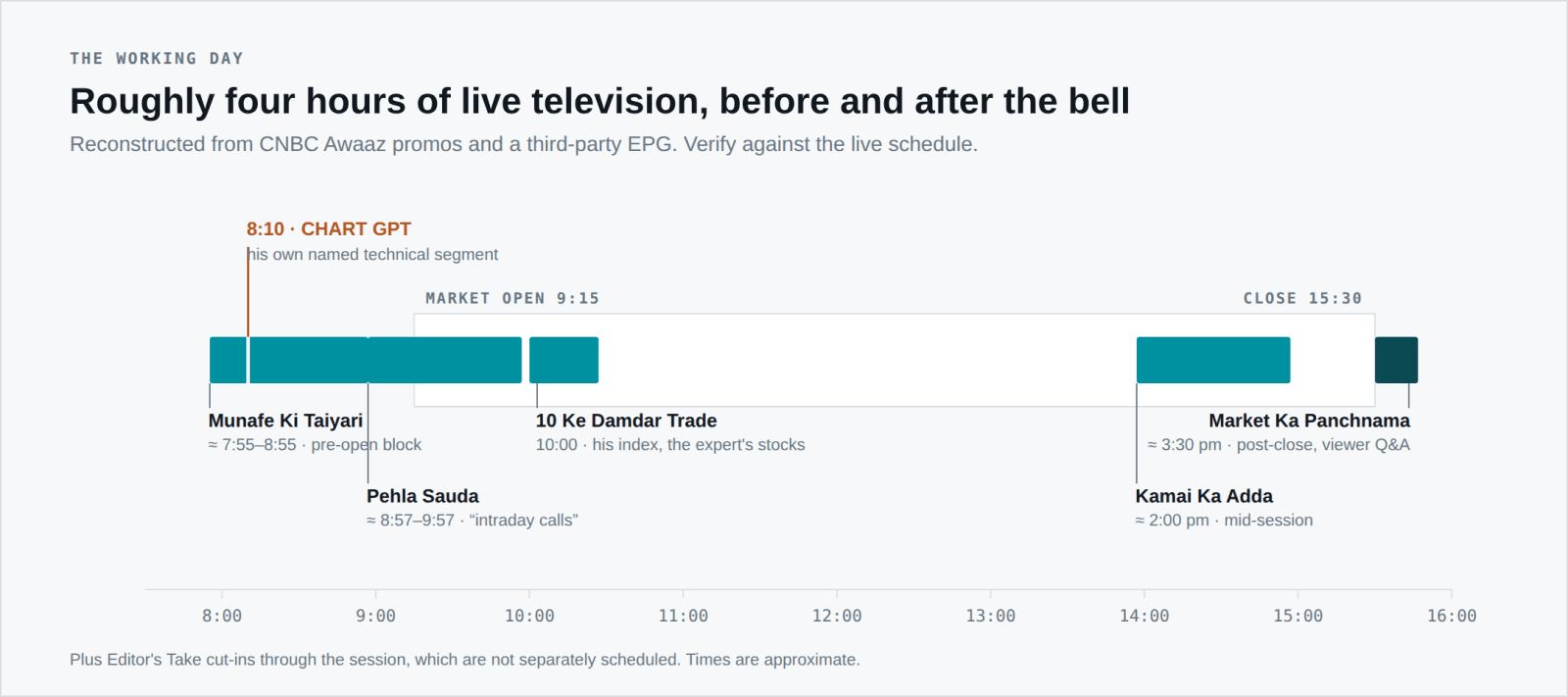
He owns the pre-open and the open — the two hours from roughly 7:55 to 9:57 that decide how a retail trader's day starts. He returns at 10:00, again in the early afternoon, and again after the close. The middle of the session, when most tips actually get given, largely belongs to other anchors and to guest experts.
That distribution matters for anyone scoring his calls. A 7:55 am statement is a plan. A 3:30 pm statement is a verdict. Marking them by the same rule is not scoring, it is a category error.
For a Managing Editor with editorial and P&L responsibility for two channels, four hours of daily live television is an unusually heavy on-air load. He has described his own routine as deliberately bounded: he starts early, delegates hard, and treats a slipping morning routine as his personal burnout alarm.
The formats, and what each one actually commits to
This is the part that matters, and it is the part nobody writes.
A "call" is not one thing. An index level is not a stock tip. A technical setup is not a target. Before you can judge whether someone is right, you have to know what they claimed — and on CNBC Awaaz the claim changes format by format.
| Format | Slot | What it is | Stocks named? | Target? | Stop-loss? | Horizon |
|---|---|---|---|---|---|---|
| Munafe Ki Taiyari | ≈ 7:55–8:55 | Pre-open block, co-anchored. Global cues, overnight news, the day's triggers, index levels. | Stocks in the news, as setup rather than as calls | Rarely from him | No | Intraday framing |
| CHART GPT | 8:10 | His own named technical segment inside the pre-open block. Billed as a deep read on the day's chart setups. | Yes, explicitly | Unverified | Unverified | Short-term technical |
| Pehla Sauda | ≈ 8:57–9:57 | Straddles the 9:15 open. The channel's own YouTube titles call it "First Trade Strategy… Intraday Calls." | Yes | Unverified | Unverified | Intraday |
| 10 Ke Damdar Trade | 10:00 | Split by design: he does the index strategy, a guest expert supplies the tradable stock calls. | Yes — by the guest | By the guest | By the guest | Intraday |
| Kamai Ka Adda | ≈ 2:00 pm | Mid-session earnings and action show. | Yes | Unverified | Unverified | Unverified |
| Market Ka Panchnama | ≈ 3:30 pm | Post-close verdict plus a live viewer Q&A. | Yes | Unverified | Unverified | Post-mortem, next session |
| Editor's Take | Cut-ins | Short editorial pieces through the day, cut for YouTube and social. This is where his own calls actually live. | Sometimes, directionally | Index levels, yes | Index-level, sometimes | Intraday to positional |
| Big Market Voices | Varies | Guest-expert interview slot. Targets here belong to the guest and are attributed on screen. | Yes | Yes — the guest's | Unverified | Varies |
| Market Gurukul | Series | Registration-based investor education. Not calls. | No | No | No | — |
Where a cell says unverified, we could not confirm it from a primary source, and we would rather leave the gap visible than fill it.
The pattern underneath the table
Read down the "target" and "stop-loss" columns and something jumps out. Anuj Singhal is an index man, not a tipster.
Across everything we could verify, his own commitments are to Nifty and Bank Nifty — delivered in a rigid, repeating four-part template of first support, bigger support, first resistance, bigger resistance, each annotated with where the level comes from ("yesterday's low", "options based", "psychological", "all-time high"). He attaches position-sizing instructions, which is rarer on television than it should be: "निफ्टी बैंक में पोजीशन कम रखें, काफी volatile हो सकता है" — keep Bank Nifty positions small, it can get volatile. And he frames stops as a symmetry argument rather than a trade ticket: if your target is 23,000, your stop should be 19,875.
The single-stock buy call with a number attached — the thing most viewers actually tune in for — is systematically handed to a named guest.
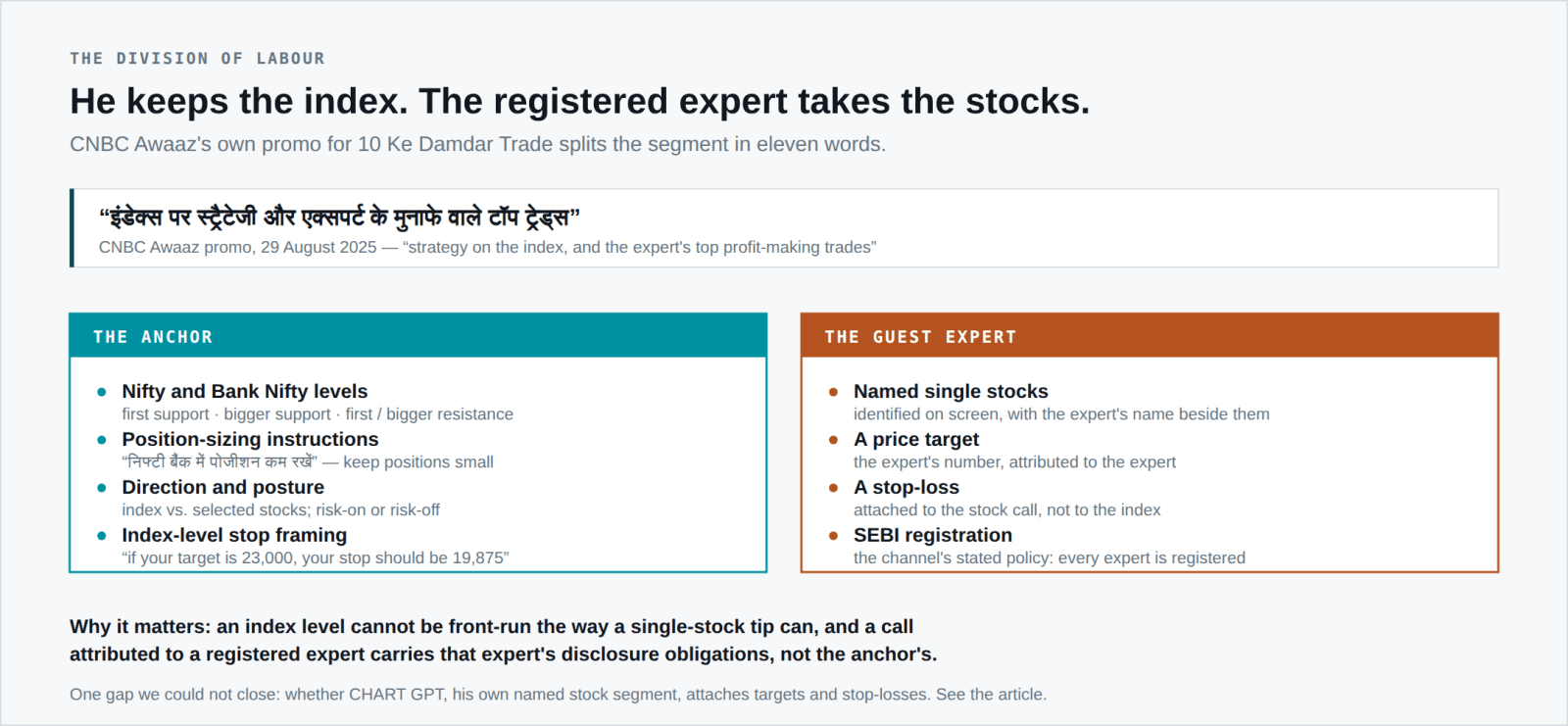
The clearest evidence is the channel's own marketing. The promo for 10 Ke Damdar Trade describes the segment as "इंडेक्स पर स्ट्रैटेजी और एक्सपर्ट के मुनाफे वाले टॉप ट्रेड्स" — strategy on the index, and the expert's top profit-making trades. Eleven words, and the whole editorial architecture is in them. His half and their half, marked out in the ad copy.
Singhal has stated the policy behind it plainly:
"As a medium, we have a great responsibility towards the investors and trading community, hence we ensure that we will not cross the line drawn by the market regulator (SEBI). All participants on CNBC-Awaaz are SEBI-registered and we never engage even a single analyst who is not registered with SEBI. This uniqueness helps us command great credibility in front of individuals, because when it involves someone registered with SEBI, there is always a mechanism for grievance redressal."
That is an absolute, checkable claim, and it sets a higher bar than SEBI actually requires. It is also a claim about guest analysts, not about anchors — who, as we explain below, are exempt anyway.
The one gap we could not close
CHART GPT is the exception that could undo the framing above. It is his own named segment, it explicitly names stocks, and we could not establish whether it attaches levels to them. Neither could we confirm what Pehla Sauda commits to, beyond the channel's own YouTube label of "Intraday Calls."
We tried. YouTube rate-limited every attempt to retrieve video descriptions. The honest answer is that this needs someone to sit through three consecutive episodes and write down what is actually said. If CHART GPT turns out to attach targets and stop-losses to named stocks, the "index man, not tipster" reading needs qualifying — and we will say so here when we know.
Worked examples: what his calls actually look like
A Bank Nifty level, 8 August 2025. Support at 55,200–55,400, bigger support at 54,900–55,100, and the instruction to keep positions small because it could get volatile. Index, two-tier support, an explicit sizing instruction. No stock. No stop-loss.
A posture, not a price — 9 May 2025. Mid-conflict, markets jumpy, weekend risk unknowable. His call was to leave the index alone and focus on selected stocks. There is no level to score here at all. It is a call about what kind of risk to take, and any scorecard that only counts entry-target-stop will miss it entirely.
A target that is not his — 16 January 2024. On Big Market Voices, a guest gave targets on two named stocks. The targets appeared on screen under the guest's name. Singhal and his co-host were the interviewers. This is the outsourcing pattern in its cleanest form, and it is why attributing that call to Singhal would be simply wrong.
The registration question, answered properly
Search his name and you will find people asking whether he is SEBI-registered. Here is the actual position.
No SEBI Research Analyst or Investment Adviser registration is publicly listed for him. We checked SEBI's RA and IA registries and found no entry. Because SEBI's registry pages are awkward to search exhaustively, we state that as "no listing found," not as proof of absence.
And under SEBI's own rules, he does not need one. SEBI's FAQ on the Research Analyst Regulations is direct:
"No. The journalists who are on the payrolls of media agency such as newspaper or television are not required to get registered with SEBI."
And separately:
"No. Any person who makes recommendation or offers an opinion concerning securities or public offers only through public media is not required to obtain registration as research analyst."
So reporting "he holds no SEBI registration" without that context would be actively misleading. He is lawfully unregistered, like every other anchor on every business channel in India.
But three real obligations survive the exemption, and these are the ones worth knowing about:
- Recommendations must rest on a registered analyst's research. Per the same FAQ, a journalist's recommendations "shall be based on the research reports of SEBI registered research analyst or any other SEBI registered intermediary permitted by SEBI to issue research report."
- The trading bar applies. Regulation 21(2) pulls Regulation 16 across to anyone making recommendations through public media. Regulation 16 prohibits dealing in a security "within thirty days before and five days after the publication of a research report." Thirty days before. That is a serious constraint, and it is the provision the front-running cases below turn on.
- Financial interest must be disclosed. Name, registration status where applicable, and any financial interest in the company being discussed.
Note also that the regulations define "research analyst" to catch people "whether or not any such person has the job title of 'research analyst'," and define "public appearance" to expressly include television. The exemption is about registration. It is not about the conduct rules.
The two CNBC Awaaz cases, and exactly where he sits in them
You cannot write about market calls on CNBC Awaaz without addressing this, and the chronology has to come first, because the chronology is the answer.
Hemant Ghai, co-host of Stock 20-20, was the subject of a SEBI ex-parte interim order on 13 January 2021. The allegation was that buy orders were placed in his wife's and mother's accounts one day before his on-air recommendations, and sold immediately after broadcast. SEBI impounded roughly ₹2.95 crore at the interim stage. Network18 terminated him the following day; its spokesperson confirmed it publicly. A confirmatory order followed in September 2021, a final order in March 2025 — disgorgement of over ₹6 crore, penalties, and a five-year market ban — and a ₹1.45 crore settlement in December 2025, made without admission or denial of the findings.
Pradeep Pandya, a CNBC Awaaz market expert whose segment was "Pandya Ka Funda," was named in a SEBI interim order on 4 October 2021, in a matter formally titled around Alpesh Furiya and connected entities. The allegation was that Pandya shared tips from his segment ahead of broadcast. SEBI imposed ₹2.6 crore in penalties across eight entities in June 2024, with five-year bans, and issued recovery notices in February 2025. Pandya had already resigned from Network18 in August 2021, two months before the order. Network18 said his actions "would constitute a clear violation of our code as well as Network18's ethical standards."
Now the chronology.
| Event | Date | Relative to Singhal as Managing Editor |
|---|---|---|
| Ghai conduct period alleged | Jan 2018 – Jan 2021 | ended ~20 months before |
| Ghai interim order and termination | 13–14 Jan 2021 | ~20 months before |
| Pandya conduct period alleged | Nov 2019 – Jan 2021 | ended ~20 months before |
| Pandya resigns | Aug 2021 | ~13 months before |
| Pandya interim order | 4 Oct 2021 | ~12 months before |
| Singhal becomes Managing Editor | 30 Sep 2022 | — |
| Pandya penalty order | 11 Jun 2024 | after |
| Ghai final order | 19 Mar 2025 | after |
Anuj Singhal is named in neither order. We searched SEBI's site, its enforcement listings and the financial press, and found no order, notice or disclosed investigation naming him — not in the Ghai matter, not in the Pandya matter, not anywhere. At the time of the alleged conduct in both cases he was Stocks Editor at CNBC-TV18, a different channel, and he had no editorial responsibility for CNBC Awaaz.
We will not write that SEBI "cleared" him, because that is not what an absence of a public record means. What we will write is the accurate version: no SEBI order or public enforcement record names Anuj Singhal.
One further clarification, because these get muddled constantly. SEBI's February 2024 order against roughly ten entities including guest experts on Zee Business is a different case, on a different channel, involving different people. And a June 2025 interim order against Sanjiv Bhasin, then at IIFL Securities, lists CNBC Awaaz among the channels he appeared on — but as a venue, not as a subject. No CNBC anchor or employee is named in it. No SEBI order has penalised CNBC Awaaz, CNBC-TV18 or Network18 as entities in any of these matters.
The impersonation problem, and why it is worse than it needs to be
This one is worth reading twice, because it is the part most likely to cost you money.
On 31 March 2024, Singhal posted on X:
"Ok everyone. This is a big scam and I have been flooded with people asking if this is real. This is OBVIOUSLY FAKE. Someone is using my image and created a WhatsApp group to promote their shitty stocks. I will be filing a police complaint has and Meta has been notified too."
Days later, CNBC Awaaz's own statement, carried by MediaNews4U on 3 April 2024:
"Anuj Singhal does not provide any investment advice or recommendations through WhatsApp groups or any other social media platform."
The documented pattern is fake profiles on Facebook and Instagram, feeding people into WhatsApp groups that promise high returns and push stocks. If a group, broadcast list or channel is offering "Anuj Singhal ke calls" — paid or free — it is not him.
And here is the gap that makes all of it easier than it should be. Neither Singhal nor CNBC Awaaz publishes a list of his official handles. The channel's alert tells viewers what is not real without telling them what is. A one-line, permanently-linked page saying "these three accounts are mine and nothing else is" would close most of this overnight. It does not exist — not for him, and as far as we can find, not for any anchor on any Indian business channel.
On the Telegram channel. A channel at t.me/singhalanuj, titled "Anuj Singhal CNBC Awaaz Managing Editor," has about 12,200 subscribers and republishes his CNBC Awaaz segments and Instagram posts. It leans genuine: he posted an "invitation to my telegram channel" on X in November 2019 and referred to its growing membership later that month, the handle matches his LinkedIn vanity URL, and it solicits nothing and sells nothing. But it carries no verification badge, no statement of ownership, and its bio is written in the third person. It also went largely quiet after late 2023, so the daily levels posts in it are a historical habit rather than current practice. We are not going to tell you it is official, and we are certainly not going to tell you it is fake. Treat it as unconfirmed.
Anuj Singhal net worth: what can and cannot be known
This is one of the most-searched things about him, so here is the straight answer.
There is no public figure for Anuj Singhal's net worth or salary, and there is no legitimate way to derive one.
The ₹15 crore figure you will find is fabricated. It comes from scraped-bio sites that also assert his height in centimetres, his weight in kilograms, a wedding date, and the names of family members — none of it sourced, some of it internally contradictory. One of those pages gives a net worth in rupees and in dollars, and the two figures do not convert into each other. That is the level of care involved.
The reason no real figure exists is procedural, and it is worth understanding because it is the same reason a real figure does exist for some other anchors.
Under Section 197(12) of the Companies Act 2013, read with Rule 5(2) of the Companies (Appointment and Remuneration of Managerial Personnel) Rules 2014, a listed company must disclose the names and remuneration of its top ten employees by pay in the Board's Report. But the second proviso to Section 136(1) lets the company leave that statement out of the annual report it actually circulates. Network18 uses that proviso. So did TV18 Broadcast before the merger. The wording in Network18's FY2024-25 Board's Report is standard:
"Having regard to the provisions of the second proviso to Section 136(1) of the Act, the Annual Report excluding the aforesaid information is being sent to the members of the Company. Any member interested in obtaining such information may address their email to…"
So the table legally exists. It is just not printed. A shareholder can request it in writing from the Company Secretary. A reader cannot.
Two more things worth knowing before anyone quotes a number at you:
- He is not a Key Managerial Personnel of Network18 and is not a director, so he does not appear in the KMP remuneration tables either. Network18's KMP are its Managing Director and its Company Secretary.
- No ESOP grant to him is disclosed anywhere. Network18's FY2024-25 report states the company issued no shares to directors or employees under any scheme that year.
For context on why this differs by employer: Zee Media's annual reports do carry the statutory employee tables, which is why a documented remuneration range exists in the public record for its Managing Editor and not for CNBC Awaaz's. Same law, different disclosure practice.
Our position: we will publish a figure the day one appears in a filing, and not a day before.
Awards: what we could verify, and what we could not
Bios describe him as award-winning. We went looking and came back with less than expected.
We found no verifiable award to Anuj Singhal personally, from any body, at any date. We searched ENBA, Ramnath Goenka, IAA, ITA, e4m's Prime Time awards and general coverage. Nothing.
We found no verifiable award to CNBC Awaaz as a channel during his editorship either. The one firmly documented ENBA win — Business News Channel of the Year (Hindi) — is from 2018, four years before he took over.
That is not the same as saying none exists. Winner lists for several recent award editions were not fully retrievable, and a channel of that size winning nothing in four years would be surprising. But if a bio tells you he is an award-winning journalist, ask which award.
One trap worth naming, because it produces most false award claims: CNBC Awaaz runs its own awards. The CNBC-Awaaz Real Estate Awards, the CEO Awards, the Travel Awards. These are sponsored industry-recognition events the channel hosts. Presiding over an awards ceremony is not the same as winning one.
The epithet "Nifty Magician" is trade-press and self-description — it appears in a podcast title and in that Telegram channel's bio. It is a nickname, not a finding.
The viewership question: 52.4% or 21.9%?
You will be shown a market-share number for CNBC Awaaz. Here is why you should ask for the definition before you believe it.

In April 2024, CNBC Awaaz publicised BARC figures showing it at 52.4% of the Hindi business news genre against Zee Business at 47.6% — target group AB males 22+, HSM urban and rural, 24 hours, Week 10 of 2024.
Seven months later, Zee Business publicised BARC figures showing itself at 77.4% and CNBC Awaaz at 21.9% — target group HSM 22+ male ABC, 06:00 to 24:00, four-week rolling average around Week 41 of 2024.
Both press releases are accurate. They are measuring different things. AB is the two most affluent NCCS bands; ABC adds a broader one. CNBC Awaaz's audience skews affluent and metro; Zee Business's skews broader and more mass. Change the target group and the leader changes with it.
Watch how the framing narrows as the claim grows, too. CNBC Awaaz's own releases moved from "NCCS AB Male 22+, 24 hours" in 2019 to "22–40 Male, HSM Urban" for Budget Day 2026 to "HSM 10 lakh-plus markets" for a 76.4% figure in Week 5 of 2026. Each is defensible. None is a season-long average.
And as of now, there is no current number at all. The Ministry of Information and Broadcasting suspended BARC's television news ratings from Week 21 of 2026 and extended the freeze to all genres in July 2026, pending BARC's re-registration under the new Television Ratings Policy. Network18's chairman cited it as a headwind in the June quarter. Any 2026 viewership claim you see is either historical or not from BARC.
Singhal's own framing of the market is worth putting beside all this. He has said Hindi controls "75 pc of the overall business channel market" — and, separately, that Hindi "still doesn't get as much advertising rates as English channels," that big corporations "clearly still have their biases against Hindi," and that "many CEOs refuse to do interviews in Hindi for the channel." Three quarters of the audience, a fraction of the rate card. That tension is the actual business story, and Network18's numbers bear it out: the group's entire standalone news business — every channel, plus Moneycontrol, News18 and Firstpost — ran at a 1.5% operating margin in the June 2026 quarter.
What he says about how he works
Four quotes that tell you more about his output than any biography would.
"Our guiding principle is simple — will our mothers understand this? If the content seems too complex, we rework it."
"First of all, we don't have a script, because the stock markets are always live. Barring headlines everything is impromptu."
"One important aspect that differentiates a stock market anchor from news anchor is, whatever he says will directly impact the lives of the people in terms of their money."
"The most significant shift is the shortening investment horizon. Earlier, investors thought long-term meant several years; today, it's barely a trading day."
That last one is the most interesting thing he has said publicly, because it is an observation about the damage the medium he runs may be doing — real-time market coverage compressing what people think "long term" means — made by the person running it.
So how should you actually read an Anuj Singhal call?
Four steps, in order.
- Identify who is speaking. If a named guest is on screen, the target and stop-loss are the guest's, and so is the accountability. Attributing an expert's stock call to the anchor is the single most common error viewers make.
- Identify what kind of claim it is. An index level is not a stock tip. A posture ("leave the index alone today") has no entry price to score. Check what was promised before you check what happened.
- Compare the stop against the current price, not the quoted one. The reasoning does not change when a stock has already moved. The risk-reward does. We have written about why the stop-loss matters more than the entry on our sister site.
- Note the exact time, and score each format against its own promise. A pre-open plan and a post-close verdict are different products. Keep the record over months, with a sample size you can state.
That last point is why this site exists. We do not advise following television calls, and we do not rate anyone. We record what aired, when it aired, and what the market did afterwards — which turns a question people argue about into a question with an answer.
Frequently asked questions
Who is Anuj Singhal?
Anuj Singhal is the Managing Editor of CNBC Awaaz and CNBC Bajar, appointed on 30 September 2022. He joined Network18 in 2003 as a research analyst at CNBC-TV18 and was that channel's Stocks Editor before moving to Awaaz.
Which shows does Anuj Singhal anchor on CNBC Awaaz?
He fronts or contributes a named segment to Munafe Ki Taiyari, CHART GPT, Pehla Sauda, 10 Ke Damdar Trade, Kamai Ka Adda, Market Ka Panchnama, Editor's Take, Big Market Voices and Market Gurukul, plus the channel's Budget programming. He does not anchor Stock 20-20, Saas Bahu Aur Sensex, Kal Ka Bazaar or Aakhri Sauda.
Does Anuj Singhal give stock tips with targets and stop-losses?
On the formats we could verify, his own commitments are Nifty and Bank Nifty levels. Single-stock calls carrying a target and a stop-loss are given by named guest experts and attributed to them on screen. The one format we could not verify is CHART GPT, his own named stock segment.
Is Anuj Singhal SEBI registered?
No SEBI Research Analyst or Investment Adviser registration is publicly listed for him, and under SEBI's own FAQ, journalists on the payroll of a television company are not required to register. The trading restrictions in Regulation 16 — no dealing in a security thirty days before and five days after a recommendation — still apply to him.
Was Anuj Singhal involved in the CNBC Awaaz SEBI cases?
No. He is named in no SEBI order. The Hemant Ghai and Pradeep Pandya matters both concern other people, and the alleged conduct in both ended roughly twenty months before he became Managing Editor of CNBC Awaaz. He was Stocks Editor at CNBC-TV18 at the time.
What is Anuj Singhal's net worth?
Not publicly knowable. Network18 excludes the statutory employee-remuneration statement from its published annual report under the second proviso to Section 136(1) of the Companies Act, so no salary figure for him exists in the public record. He is not a Key Managerial Personnel and no ESOP grant to him is disclosed. Any specific rupee figure you find online is invented.
How old is Anuj Singhal?
Undocumented. No primary or reputable source gives his age, birth year or date of birth. The birth years circulating online appear only on scraped-bio sites and should not be relied on.
Does Anuj Singhal have a WhatsApp or Telegram tips group?
CNBC Awaaz has stated that he "does not provide any investment advice or recommendations through WhatsApp groups or any other social media platform," and he has publicly reported a fake WhatsApp group using his image. A Telegram channel using his name exists and appears likely to be his, but carries no verification. Anyone offering paid calls in his name should be assumed fraudulent.
Related reading
- How to Read TV Trade Signals (Without Getting Burned)
- Anil Singhvi: Who He Is, What He Actually Says on Air, and How to Read It
- Browse every signal in the database · Performance analytics
Disclaimer: CNBCAwaazLive is an independent television signal record. It is not affiliated with, endorsed by, or sponsored by CNBC Awaaz, CNBC-TV18, Network18 Media & Investments Ltd, or CNBC. Nothing here constitutes investment advice. Data is automatically captured and may contain errors. Consult a SEBI-registered adviser before acting on any signal.
Sources: BestMediaInfo (26 Aug 2011) and IndianTelevision (25 Aug 2011) on the Bloomberg UTV move; exchange4media, Adgully and Samachar4media (30 Sep–1 Oct 2022) on the Managing Editor appointment; MediaBrief (19 Oct 2023, 10 Feb 2026); medianews4u (10 Oct 2023, 31 Jan 2026); afaqs (17 Oct 2023); exchange4media (30 Apr 2025); Adgully (30 Jan 2026); SEBI interim order 13 Jan 2021 and final order 19 Mar 2025 (Hemant Ghai); SEBI interim order 4 Oct 2021 (Alpesh Furiya and connected entities / Pradeep Pandya) and penalty order 11 Jun 2024; SEBI interim order 17 Jun 2025 (Sanjiv Bhasin); SEBI Research Analyst Regulations 2014 and SEBI FAQs (circular of 23 Jul 2025); The Caravan (24 Jan 2021) and Newslaundry (5 Oct 2021) for Network18's statements; Network18 Media & Investments Ltd Annual Report FY2024-25 and FY2025-26; medianews4u, Adgully, Storyboard18 (4 Apr 2024) and MediaBrief (6 Nov 2024) on BARC; exchange4media (3 Jun 2026) and Business Standard (5 Jul 2026) on the ratings suspension; @_anujsinghal on X (18 Nov 2019, 31 Mar 2024); MediaNews4U (3 Apr 2024) on the impersonation alert.